




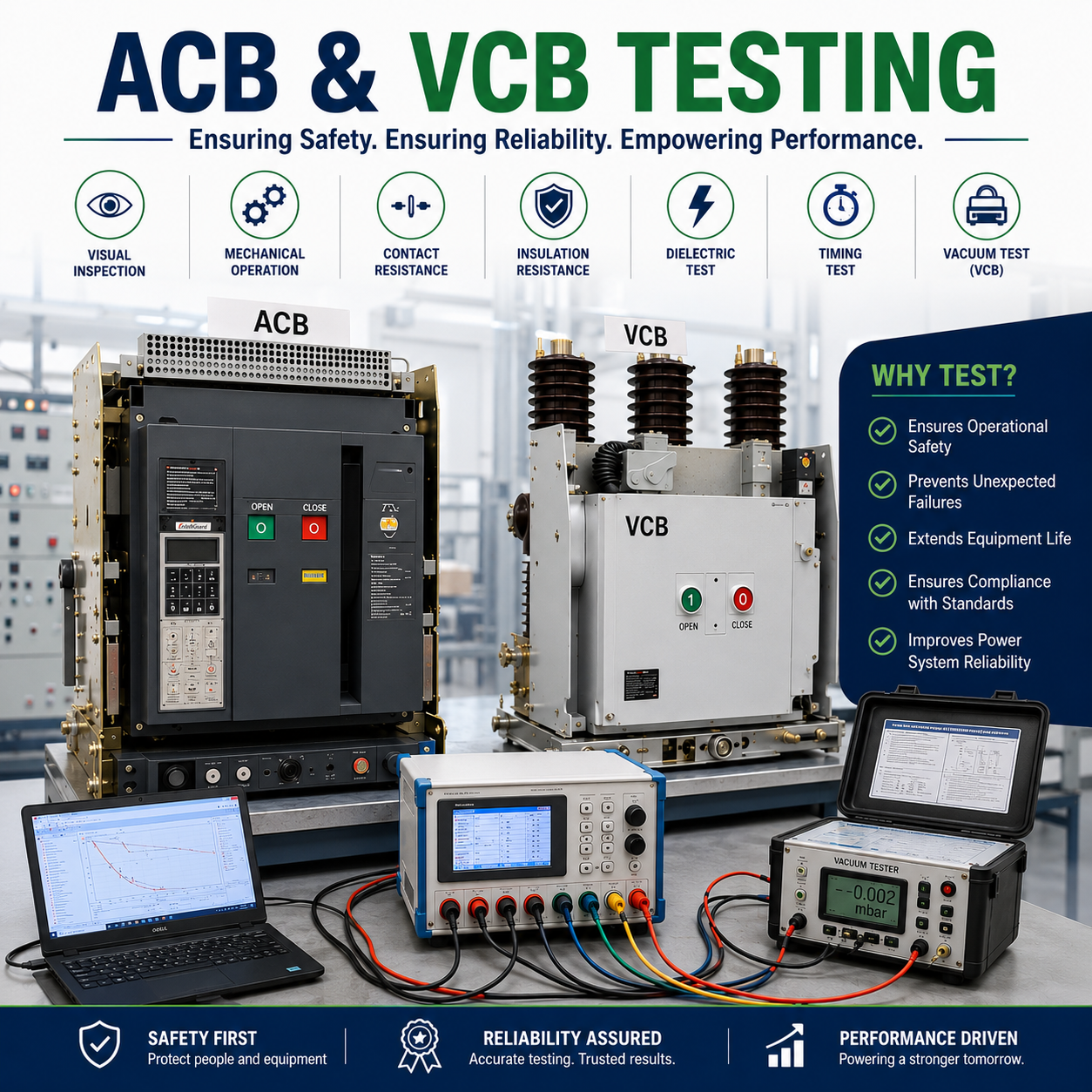
Maintaining electrical safety, improving equipment dependability, and avoiding unexpected power failures in industrial facilities all depend on selecting a reputable ACB VCB testing service provider in India. Vacuum circuit breakers (VCBs) and air circuit breakers (ACBs) are important parts of electrical distribution networks. By cutting off electricity during overloads, short circuits, and other fault situations, they safeguard electrical equipment. However, for circuit breakers to function properly, routine testing, inspection, and preventative maintenance are necessary. Choosing a seasoned testing service provider enables businesses to spot such issues before they result in equipment damage, production delays, or risks to safety.
What Are ACB and VCB Testing Services?
Circuit breakers are checked and evaluated as part of ACB and VCB testing services to confirm their performance, protective features, and operational state. Low-voltage circuit breakers that are frequently found in power control systems, industrial switchboards, and electrical distribution panels are the subject of air circuit breaker (ACB) testing. Medium-voltage breaker circuit breakers that require a vacuum voltage interrupter to put out the electrical arc during switching operations are tested for vacuum circuit breakers (VCBs). Contact resistance testing, insulation resistance testing, mechanical operation checks, trip and closure timing measurements, protective relay or trip-unit verification, and other tests may be performed according to the equipment design and manufacturer guidelines.
Why Choosing the Right ACB & VCB Testing Company Matters
Electrical circuit breakers must operate correctly when a fault occurs. A breaker that fails to trip, operates too slowly, or has excessive contact resistance can increase the risk of equipment damage and unplanned shutdowns.
Working with a qualified testing company offers several benefits:
- Improved electrical safety: Helps identify defects that could affect the safe operation of electrical systems.
- Reduced downtime: Detects potential problems before they develop into major failures.
- Better equipment reliability: Confirms that important operating and protective functions are working as intended.
- Preventive maintenance planning: Provides test results that help maintenance teams prioritize repairs.
- Maintenance documentation: Supports maintenance records, technical reviews, and future inspections.
A reliable service provider should explain the purpose of each test and provide clear findings rather than simply completing a checklist.
7 Factors to Consider When Choosing a Reliable ACB VCB Testing Service Provider in India
1. Check Technical Experience and Expertise
The first step is to evaluate the provider’s experience with industrial electrical equipment. ACB and VCB models differ in their construction, ratings, operating mechanisms, and testing requirements.
Choose a team familiar with the types of circuit breakers installed at your facility. Ask about its experience with low-voltage panels, medium-voltage switchgear, industrial distribution systems, and different breaker manufacturers.
An experienced team can identify warning signs such as abnormal operating mechanisms, worn contacts, loose connections, or inconsistent tripping performance.
2. Verify Testing Instruments and Procedures
Accurate measurements depend on suitable testing instruments and correct procedures.
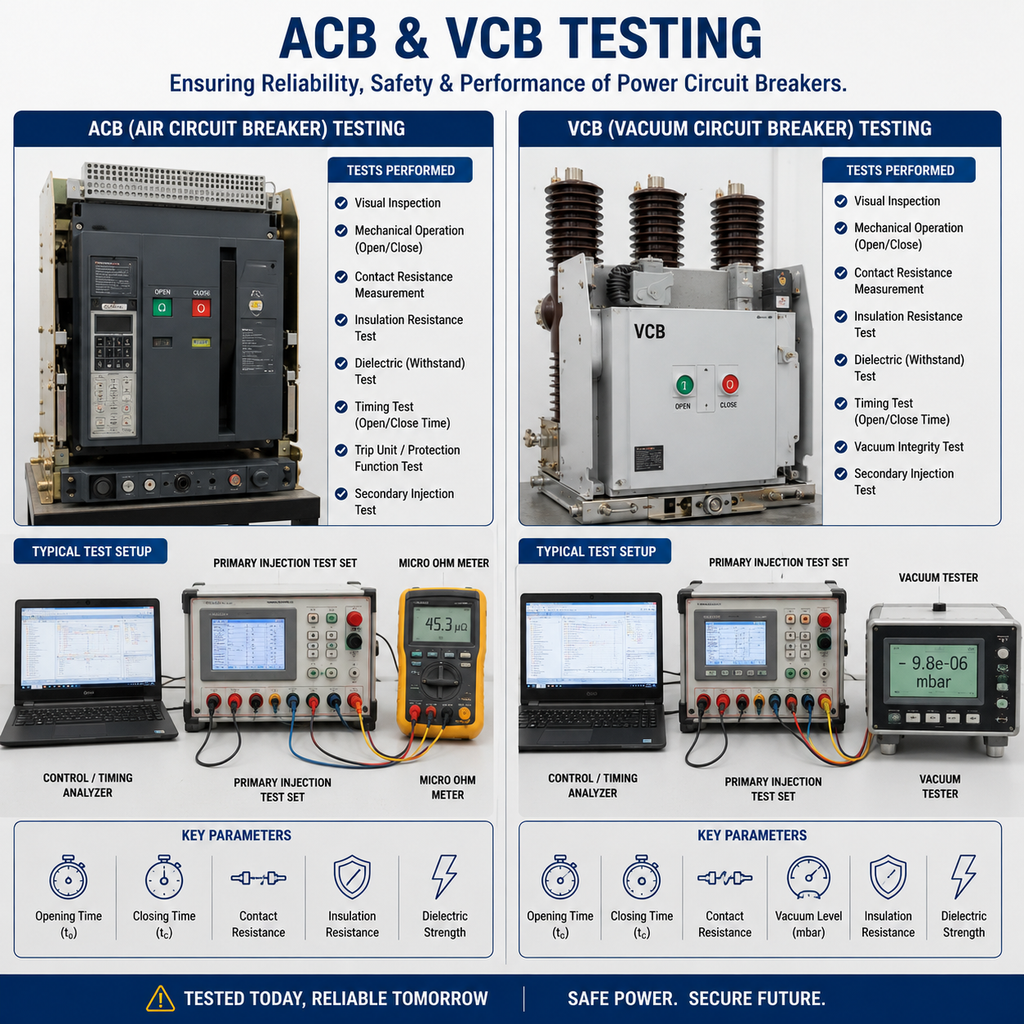
A professional ACB and VCB testing service provider should use appropriate, maintained, and calibrated instruments wherever required for the specified tests. Depending on the scope, equipment may include micro-ohm meters, insulation resistance testers, breaker timing analyzers, and primary or secondary injection test equipment.
Ask the provider whether testing procedures follow the applicable manufacturer instructions, equipment specifications, and relevant electrical standards.
3. Review the Range of Testing Services
Before selecting a contractor, confirm that it can perform the tests required for your installation.
Typical ACB and VCB testing activities may include:
- Visual inspection and mechanical condition assessment
- Contact resistance measurement
- Insulation resistance testing
- Opening and closing operation checks
- Breaker timing and pole synchronization tests, where applicable
- Trip-unit and protective relay verification
- Functional checks of electrical and mechanical interlocks
- Inspection of auxiliary contacts and control circuits
Not every test is appropriate for every breaker. The final testing plan should consider the breaker design, service history, operating conditions, and manufacturer recommendations.
4. Ask About Safety Procedures and Site Readiness
Electrical testing can involve hazardous energy and high-voltage equipment. Safety procedures must therefore be a priority.
A competent service provider should coordinate with the facility’s electrical team, follow applicable isolation and lockout/tagout procedures, verify the absence of voltage where required, and establish suitable work boundaries.
Testing should be performed by qualified personnel using appropriate personal protective equipment and approved work procedures.
For critical installations, discuss shutdown requirements, permits, emergency arrangements, and the steps needed to return the equipment to service safely.
5. Evaluate Reporting and Documentation
A professional testing company should provide a clear report of the work completed.
A useful report typically identifies the equipment, records the tests performed, documents measured values, references applicable acceptance criteria where available, and lists any abnormal findings.
It should also distinguish between satisfactory results, observations requiring attention, and defects that need corrective action.
Proper documentation helps facility managers compare results over time, schedule maintenance, support audits, and make informed repair or replacement decisions.
6. Compare Service Scope, Cost, and Response Time
Price is an important consideration, but the lowest quotation may not provide the best value. Compare providers based on their testing scope, technician qualifications, instruments, reporting quality, safety arrangements, travel requirements, and support after testing. Ask whether the quotation includes inspection, testing, report preparation, troubleshooting, and retesting after corrective work. Clarify any additional charges before approving the job. Also consider response time and the provider’s ability to coordinate planned shutdowns. For facilities where electrical reliability is critical, dependable scheduling can be as important as the initial service cost.
7. Check References and Customer Support
Before finalizing your decision, ask for relevant project experience or customer references, where available. Look for experience in factories, commercial buildings, infrastructure projects, and other facilities with comparable electrical systems. A dependable provider should communicate findings clearly and explain which issues require immediate attention and which can be addressed through planned maintenance. Choose a company that offers practical technical guidance rather than making unsupported promises about equipment performance.
When Should ACB and VCB Testing Be Performed?
The appropriate testing frequency depends on manufacturer guidance, operating conditions, equipment criticality, fault history, and applicable requirements.
Testing and inspection may be required during:
- Initial commissioning or installation
- Planned electrical shutdowns
- Preventive maintenance programs
- Investigations following a fault or abnormal operation
- Repairs, refurbishment, or replacement of components
- Periodic assessments based on equipment condition and risk
Facilities operating in dusty, humid, hot, or demanding industrial environments may need particular attention to equipment condition. Maintenance intervals should be established through a suitable risk-based plan rather than applying the same schedule to every breaker.
Why Choose Greenventum Powertech Solutions?
Greenventum Powertech Solutions provides electrical engineering, testing, and maintenance-related solutions to industrial clients. Discuss about your equipment ratings, installation specifics, maintenance histories, and the particular tests required when assessing Greenventum for your ACB and VCB testing needs. A clear scope makes it more likely that the work will meet the operational and safety needs of your facility. By setting up the service, get details about the proposed testing process, available tools, technician certifications, reporting format, and repair advice. The goal is to collect important test data that assist your maintenance staff in making well-informed selections about the performance of electrical equipment.
Conclusion
The program is important to carefully assess technical know-how, testing equipment, safety protocols, paperwork, service scope, and customer support when choosing a reliable ACB VCB testing service provider in India. Routine, well-planned testing may promote proactive maintenance, help to find circuit breaker problems, and reduce the probability of random power outages. Industrial facilities may maintain a more reliable and safe electrical distribution system by selecting a certified service partner and according to manufacturer guidelines.
Frequently Asked Questions (FAQs)
1. What is included in ACB and VCB testing services?
Depending on the breaker and testing scope, services may include visual inspection, contact resistance measurement, insulation resistance testing, mechanical operation checks, timing tests, and verification of trip functions.
2. How often should ACB and VCB testing be performed?
Testing frequency depends on manufacturer recommendations, operating conditions, equipment criticality, maintenance history, and applicable requirements. A qualified professional can help establish a suitable schedule.
3. Why is contact resistance testing important?
Contact resistance testing helps identify abnormal resistance across breaker contacts and connections. Elevated resistance may indicate deterioration, contamination, poor contact pressure, or other issues requiring investigation.
4. How do I select an ACB and VCB testing company in India?
Evaluate technical experience, testing equipment, safety procedures, relevant project experience, documentation quality, service scope, and the provider’s ability to explain test results clearly.
5. Can regular circuit breaker testing prevent electrical failures?
Testing can identify certain developing defects before they cause a failure. However, it cannot eliminate every risk, so testing should be combined with appropriate maintenance, inspections, and corrective action.
Comments are closed