




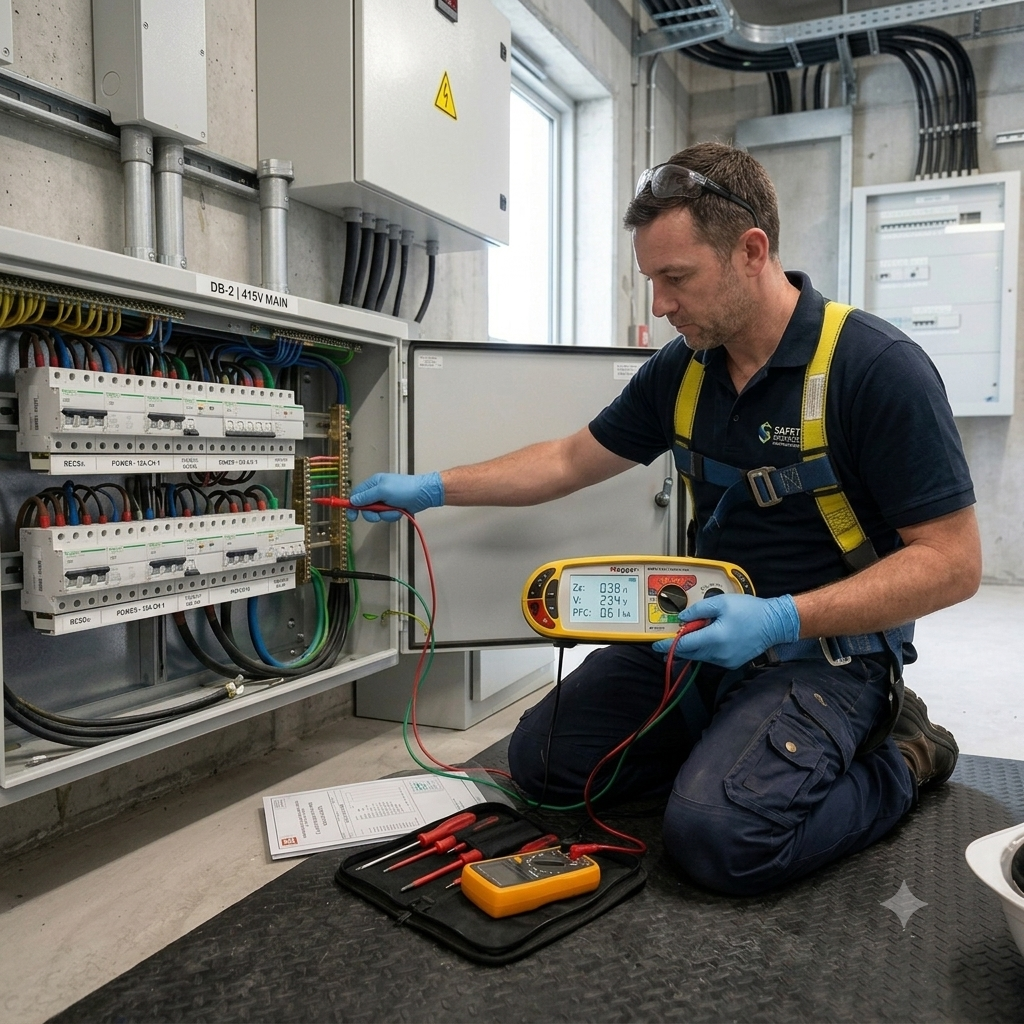
When there exists a defect in an electrical installation, the protective device must promptly disconnect the supply. If not, exposed metal parts may remain active, exposing people and equipment. Loop impedance testing guarantees that your protection will operate when needed. Greenventum Powertech Solutions discusses what loop impedance testing is, how it works, how to interpret the findings, and when it should be performed.
What Is Loop Impedance Testing?
Loop impedance testing determines the overall impedance of the path that a fault current would travel. That path begins at the supply transformer, continues via the line conductor to the problem location, and returns via the protecting earth conductor. The result is termed earth fault loop impedance (Zs) and measured in ohms (Ω). The reason is clear and simple. Low impedance testing allows a high fault current to flow, causing the fuse or breaker to trip quickly. High impedance limits current flow, therefore the device may trip slowly or not at all.
Understanding the Loop Impedance Formula
The earth fault loop impedance is made up of two parts:
Zs = Ze + (R1 + R2)
- Ze: the external impedance of the supply side, including the transformer and the supply’s earth path.
- R1: the resistance of the line conductor from the origin to the point being tested.
- R2: the resistance of the protective conductor (CPC) over the same run.
Fault current follows Ohm’s law: voltage divided by Zs. At 230 V with a Zs of 0.5 Ω, the fault current is 460 A, which is enough to trip most protective devices almost instantly.
Why Is Loop Impedance Testing Important?
Regular loop impedance testing is essential to electrical safety. Here is why it matters:
- Shock protection: it confirms that faulty equipment is disconnected before a dangerous touch voltage persists.
- Fire prevention: high-impedance faults can overheat cables and connections without tripping the breaker.
- Compliance: standards such as IEC 60364 and BS 7671 require verification at commissioning and during periodic inspection, and Indian practice follows IS 732 and IS 3043.
- Equipment protection: quick fault clearance limits damage to motors, panels and cables.
- Early warning: rising readings point to loose terminations, corrosion or a weakening earthing system.
Equipment Used: The Loop Impedance Tester
A loop impedance tester briefly draws a small current between the line and earth, measures the resulting voltage drop and calculates impedance. Modern models offer:
- A no-trip mode for circuits protected by RCDs
- Measurement of prospective fault current, the maximum current that could flow in a fault
- Data storage for trending and reports
Like any test instrument, the tester must be calibrated and its leads checked before use.
How to Perform Loop Impedance Testing (Step by Step)
If you are wondering how to carry out loop impedance testing correctly, here is the general procedure. This work should only be done by trained and authorised personnel, because parts of it are carried out on live circuits.
- Inspect visually for damaged cables, loose connections and missing earth conductors.
- Check protective conductor continuity (R1 + R2) with the supply isolated.
- Measure Ze at the origin, following a safe procedure for the installation.
- Check the tester and leads, and nullify lead resistance if the instrument requires it.
- Connect the tester at the furthest point of each circuit, such as the last socket or the equipment terminals.
- Select the correct mode. Use no-trip mode where an RCD is present.
- Run the test and record the Zs reading.
- Compare the result with the maximum permitted value for that protective device.
- Record and restore, noting the readings, test conditions and any defects found.
Maximum Zs Values: What Is Acceptable?
The pass or fail decision in loop impedance testing depends on the protective device, its rating and the required disconnection time. In TN systems at 230 V, final circuits up to 32 A generally need to disconnect within 0.4 seconds, while distribution circuits are allowed up to 5 seconds.
Typical maximum Zs values for Type B circuit breakers at 0.4 seconds (BS 7671):
| Type B MCB Rating | Maximum Zs |
| 6 A | 7.28 Ω |
| 10 A | 4.37 Ω |
| 16 A | 2.73 Ω |
| 20 A | 2.19 Ω |
| 25 A | 1.75 Ω |
| 32 A | 1.37 Ω |
Always confirm values against the standard, the device curve and your local code. As a practical rule, measured readings are often expected to stay below about 80% of the tabulated maximum, because conductor resistance rises as cables heat up under fault conditions.
Common Causes of High Loop Impedance
If loop impedance testing returns a high reading, the usual causes are:
- Loose, corroded or poorly made terminations
- Undersized or damaged cables
- Very long cable runs
- A broken or missing protective conductor
- A weak supply-side earth connection (high Ze)
- Faulty joints and connectors
Fixes include tightening or remaking connections, upgrading conductors, shortening circuit lengths, improving the earthing system or adding RCD protection. Re-test after every correction.
When Should You Carry Out Loop Impedance Testing?
Schedule loop impedance testing:
- During commissioning of new installations
- After any alteration, extension or repair of a circuit
- As part of periodic inspection and preventive maintenance
- After a fault, fire, flood or electrical incident
- Before taking over or handing over a building or plant
How It Fits With Other Electrical Tests
Loop impedance testing is usually carried out alongside insulation resistance, earth resistance, continuity and RCD tests. Together they give a complete picture of installation safety. The loop test checks that faults will clear, while the insulation test checks that faults are less likely to occur.
Professional Electrical Testing Services From Greenventum
Reading is easy. Interpreting it correctly takes experience, and testing live circuits safely takes training. At Greenventum Powertech Solutions, our electrical testing services include calibrated loop impedance test procedures, prospective fault current checks, clear reports and practical recommendations for factories, commercial buildings, solar plants and utilities.
Conclusion
Loop impedance testing is a fast, low-cost way to prove that your protective devices will clear a fault in time. By understanding Zs, maximum values and common causes of high readings, you can fix weak points before they become hazards. It is not just a compliance task. It protects people, equipment and uptime.
Comments are closed