




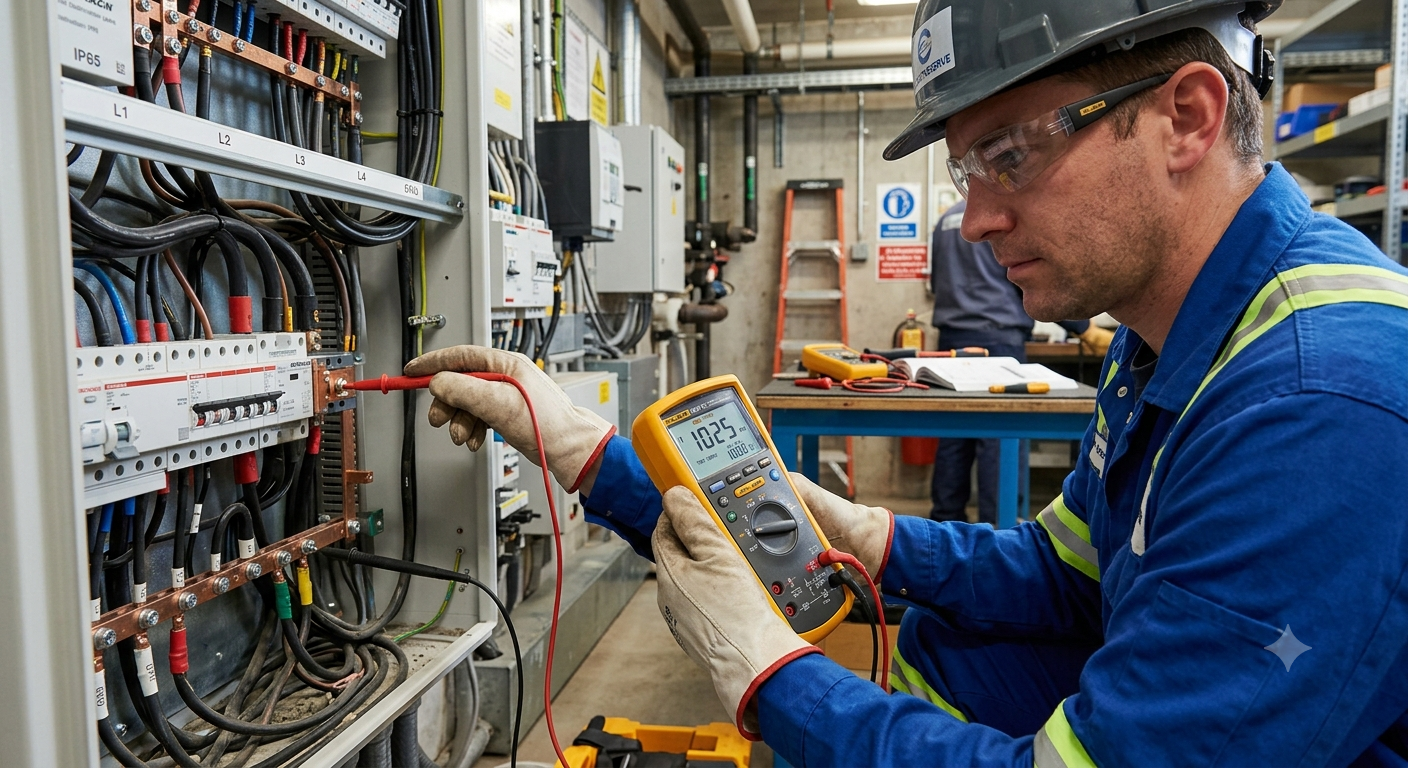
Extremely rarely do electrical problems occur quickly. Generally then not, the insulation that protects your cables, motors, transformers, and switchgear gradually deteriorates until it finally breaks, resulting in equipment damage, downtime, or even fire. One of the simplest and most efficient ways to identify such damage early on is to conduct an insulating resistance test. This guide from Greenventum Powertech Solutions describes what an insulation resistance testing service is, how it operates, which test voltages to use, how to interpret the findings, and when to schedule it.
What Is an Insulation Resistance Test?
The resistance of electrical insulation between conductors or between a conductor and the ground is measured by an insulation resistance testing. The little leakage current that passes through the insulation is measured when a high DC voltage is put across it. The device uses this information to calculate resistance, which is often expressed in megaohms (MΩ) or gigaohms (GΩ). A high number is suggestive of healthy insulation’s resistance to current flow. The measurement decreases when insulation is moist, contaminated, old, or damaged because it permits greater leakage current. This is sometimes referred to as a “megger test,” named for the popular brand of measuring instrument used to perform it.
Why Is Insulation Resistance Testing Important?
Regular insulation resistance testing is a core part of preventive maintenance. Here is why it matters:
- Safety: Weak insulation can cause electric shock, short circuits and fires.
- Reliability: Detecting faults early prevents unexpected breakdowns of motors, cables and transformers.
- Cost savings: Planned repairs cost far less than emergency replacement and lost production.
- Compliance: Standards and regulations require testing during commissioning and periodic inspection.
- Asset life: Trending results over time helps you predict remaining insulation life.
Equipment Used: The Megohmmeter
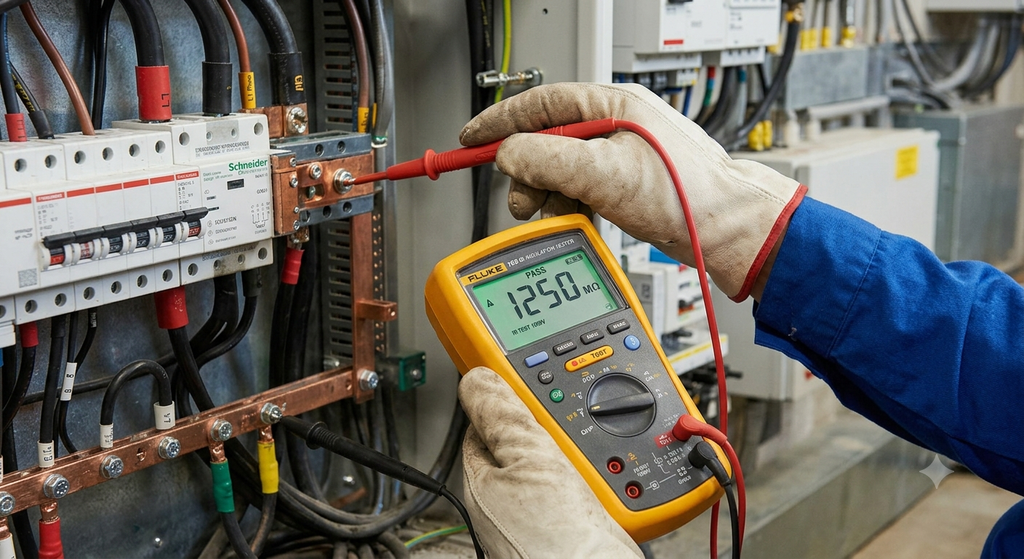
A megohmmeter (insulation tester) generates a stable, high DC test voltage and measures the resulting resistance. Modern digital models offer selectable test voltages, automatic timing, guard terminals, and data storage for trending. Choosing the right instrument and voltage is essential for accurate, safe results.
How to Perform an Insulation Resistance Test (Step by Step)
If you are wondering how to carry out a megger test correctly, here is the general procedure. This work should only be done by trained and authorised personnel.
- Isolate and de-energise the equipment, then lock out and tag out.
- Disconnect sensitive electronics, surge protectors, capacitors and VFDs that could be damaged by the test voltage.
- Verify dead using an approved voltage detector.
- Discharge any stored energy and connect the equipment to earth.
- Select the test voltage based on the equipment’s rated voltage.
- Connect the leads between the conductor under test and earth (or between phases).
- Apply the test voltage for the required time, commonly one minute.
- Record the reading, along with temperature and humidity.
- Discharge the equipment again after the test, because insulation can hold a dangerous charge.
Recommended Test Voltages
| Equipment Rated Voltage | Typical Test Voltage |
| Up to 100 V | 250 V DC |
| 100 V to 440 V | 500 V DC |
| 440 V to 600 V | 500 V to 1,000 V DC |
| 2.4 kV to 5 kV | 1,000 V to 2,500 V DC |
| Above 5 kV | 2,500 V to 5,000 V DC |
Always follow the manufacturer’s guidance and applicable standards such as IEC 60364-6 or IEEE 43.
What Is an Acceptable Insulation Resistance Value?
The acceptable insulation resistance value depends on the equipment type, voltage rating, age and temperature. Some commonly used guidelines:
- Low-voltage installations: a minimum of about 1 MΩ at 500 V DC, per IEC 60364-6.
- Motors and generators: a common rule of thumb is a minimum of 1 MΩ per kV of rated voltage, plus 1 MΩ.
- New equipment: typically reads in the hundreds or thousands of megaohms.
Rather than relying on one number, look at the trend. A steady downward drift across several tests is a warning sign, even if readings stay above the minimum.
Temperature matters. Insulation resistance roughly halves for every 10°C rise in temperature, so readings should be corrected to a standard reference temperature (usually 40°C) before comparison.
Beyond the Spot Test: Polarization Index and DAR
A single one-minute reading only tells part of the story. For motors, generators and transformers, engineers often add time-based tests:
- Dielectric Absorption Ratio (DAR): the 60-second reading divided by the 30-second reading.
- Polarization index test (PI): the 10-minute reading divided by the 1-minute reading.
A polarization index test result of 2.0 or higher generally indicates good insulation, while a value below 1.0 suggests serious problems. These ratios are valuable because they are less affected by temperature, so they give a clearer picture of insulation condition.
Common Causes of Low Insulation Resistance
If your insulation resistance test returns poor results, the usual suspects are:
- Moisture or condensation
- Dust, oil and chemical contamination
- Overheating and thermal ageing
- Mechanical damage or vibration
- Rodent damage to cables
- Voltage stress and partial discharge
Cleaning and drying the equipment, or re-testing after correcting the cause, often restores acceptable readings. If it does not, rewinding or replacement may be required.
When Should You Carry Out an Insulation Resistance Test?
Schedule insulation resistance testing:
- During commissioning of new installations and equipment
- After repairs, rewinding or modification
- Before restarting equipment that has been idle or stored
- After floods, water ingress or fire exposure
- As part of routine preventive maintenance (typically annually, or as per site policy and risk level)
Equipment That Benefits From Testing
The test applies across almost every electrical asset, including LT and HT cables, induction motors and generators, power and distribution transformers, switchgear and busbars, solar PV strings and inverters, and household and industrial wiring.
Professional Electrical Testing Services From Greenventum
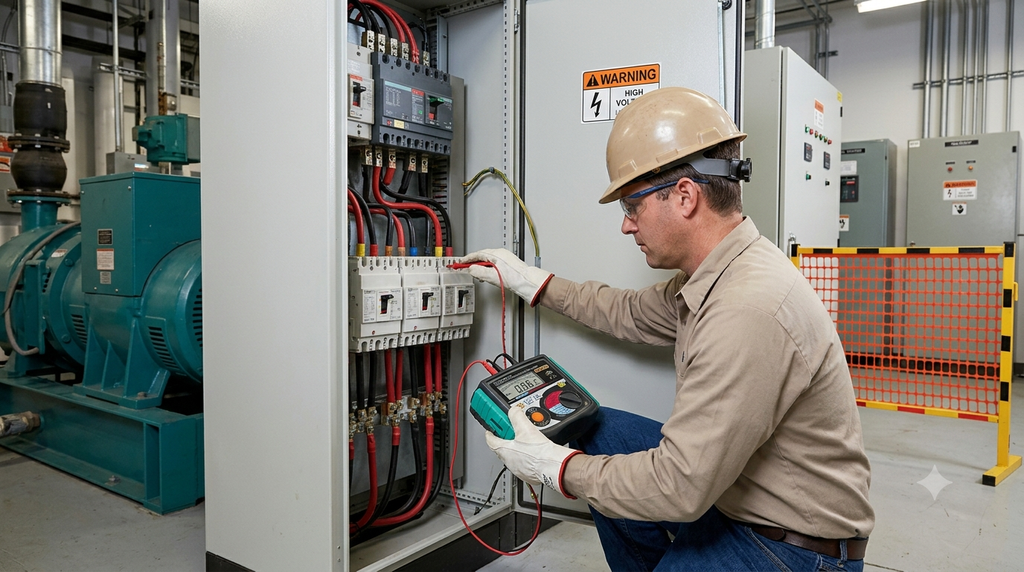
Interpreting results correctly takes experience. A reading that looks acceptable on paper may hide a developing fault, and an unsafe procedure can damage equipment or injure people. At Greenventum Powertech Solutions, our electrical testing services include calibrated megger test procedures, polarization index test analysis, detailed reports and practical recommendations to keep your plant safe and running. Whether you manage a factory, commercial building, solar plant or utility network, our engineers can help you build a testing schedule that reduces risk and protects your investment.
Conclusion
An insulation resistance test is a quick, low-cost and highly effective way to check the health of your electrical insulation. By understanding test voltages, acceptable values and trending, you can find problems before they become failures. Regular testing is not just a compliance task. It is an investment in safety and uptime.
Book your insulation resistance test with Greenventum today!
Comments are closed