




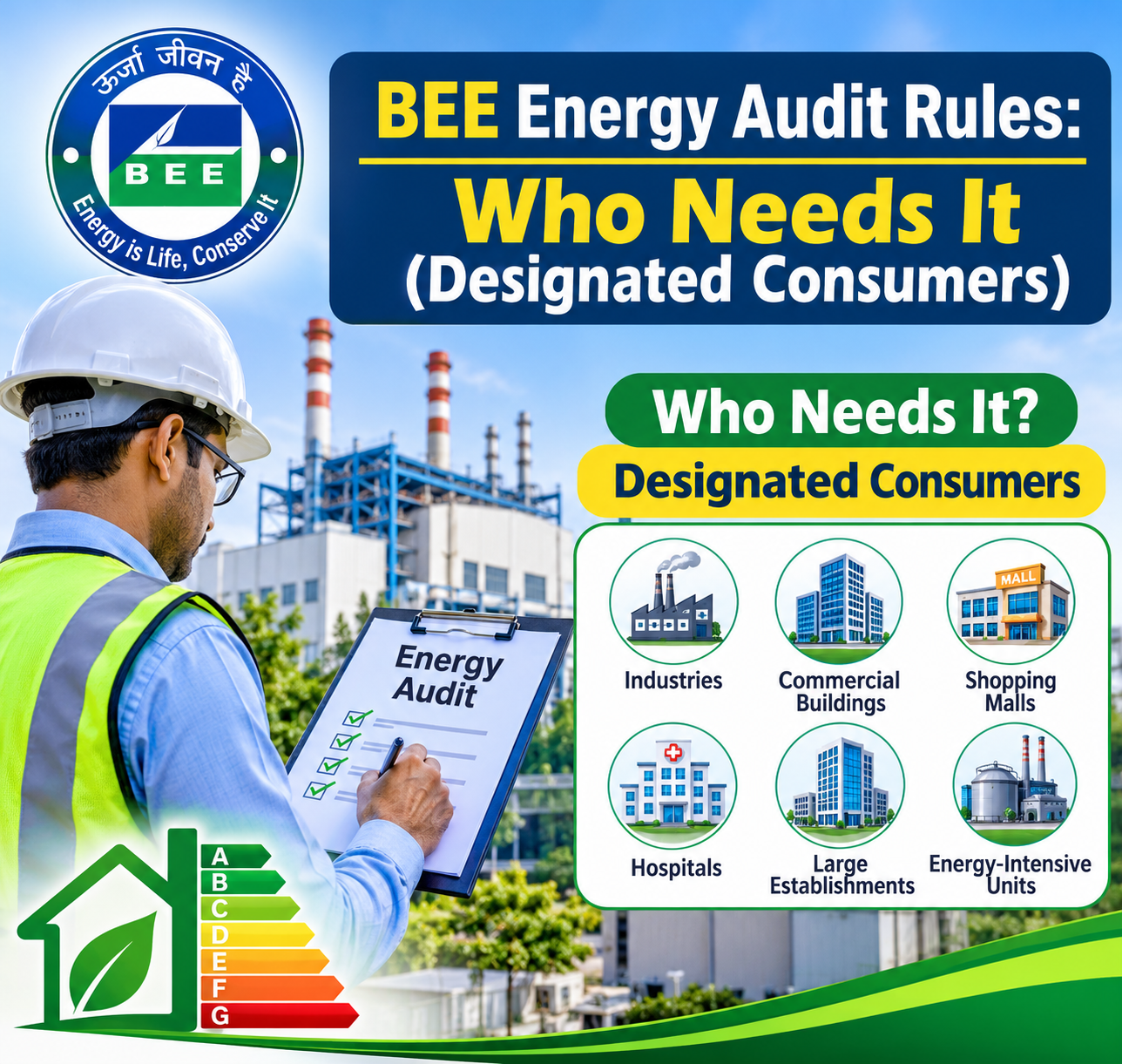
Before making plans for energy improvements, a lot of company owners want to know if energy audits are mandatory in India. To identify specific organizations, the response is yes, but not for others. The possibility that your business qualifies as a “designated consumer” under the Energy Conservation Act of 2001 will impact this. This guide outlines who needs to follow the rules, what they are, and what happens if you don’t.
Is Energy Audit Mandatory in India?
Does India need energy audits? Absolutely, though only with specific customers who have been provided with information from the Indian government according with the Energy Conservation Act of 2001. These include commercial buildings that exceed a certain energy-use limit, railroads, ports, airports, power utilities, and significant energy-consuming industries. Despite most firms gaining from auditing, some aren’t legally required to do so.
What Is the BEE and the Energy Conservation Act?
The Bureau of Energy Efficiency (BEE) is the central agency under the Ministry of Power that promotes efficient energy use. It enforces the Energy Conservation Act, 2001, which was amended in 2022 to strengthen compliance and introduce a carbon credit trading framework.
Under this law, BEE can identify energy-intensive consumers and make audits, reporting and energy management compulsory for them.

Who Are Designated Consumers?
Designated consumers are facilities notified under Section 14(e) of the Act. The notified categories include:
- Aluminium, cement, fertiliser, iron and steel, chlor-alkali, pulp and paper, textile and sugar units
- Petrochemicals, refineries and thermal power stations
- Railways, port trusts and airports
- Electricity transmission and distribution companies
- Commercial buildings and establishments with high connected load or contract demand
Each industrial sector has its own annual energy consumption threshold, measured in metric tonnes of oil equivalent (toe). For commercial buildings, the cut-off is set by connected load or contract demand. Thresholds are revised from time to time, so always confirm the latest notification on the BEE website.
What Do BEE Energy Audit Rules Require?
A designated consumer must follow these obligations:
- Appoint an energy manager. The person must be a BEE-certified energy manager.
- Get an energy audit done. The audit must be carried out by a BEE-accredited energy auditor, generally once every three years.
- Submit annual returns. Energy consumption data and details of actions taken are filed with the designated state agency, in the prescribed format.
- Follow prescribed norms. Facilities must meet energy consumption standards where notified, including targets under the Perform, Achieve and Trade (PAT) scheme.
- Act on recommendations. Cost-effective findings from the audit should be implemented, and results reported.
Why the Law Makes Audits Compulsory
India’s energy demand is rising fast, and industry accounts for a large share of it. Mandatory audits help the government reduce energy intensity, cut emissions and improve grid reliability. For the facility, the audit becomes a roadmap for lowering power costs.
Penalties for Non-Compliance
Under the Act, failing to comply can lead to a penalty that may extend to ten lakh rupees. A continuing failure can attract an additional daily penalty. Beyond fines, non-compliance can harm your reputation with regulators, lenders and clients, and may affect your standing in PAT and other efficiency programmes.
What If You Are Not a Designated Consumer?
If your facility falls below the thresholds, the law does not require a BEE audit. Even so, a voluntary audit is worthwhile in many cases:
- Your electricity bill is a major cost
- Your power factor is low or maximum demand keeps rising
- You plan solar, EV charging or equipment upgrades
- You want to meet ESG or green building goals
- Lenders, insurers or customers ask for efficiency data
Voluntary audits often uncover savings of 10 to 25 percent on energy cost, and many measures pay back within one to three years.
Types of Energy Audit
- Preliminary audit: A quick walk-through and bill review to spot obvious losses.
- Detailed audit: Instrument-based measurement of motors, lighting, HVAC, boilers, compressors and transformers.
- Investment-grade audit: A full financial study for large projects such as solar, VFDs or chiller replacement.
Designated consumers need the detailed, accredited version to satisfy statutory requirements.

How to Prepare for a BEE-Compliant Audit
- Collect 12 to 36 months of electricity bills and fuel records.
- List all major equipment with ratings and operating hours.
- Gather single-line diagrams and previous audit reports.
- Nominate a coordinator, ideally your energy manager.
- Choose an accredited auditor with experience in your sector.
Good preparation shortens the audit and improves the accuracy of the findings.
Conclusion
So, is energy audit mandatory in India For designated consumers, yes. It is a legal requirement backed by penalties. For everyone else, it is not compulsory, but it remains one of the smartest ways to control energy costs, improve reliability and prepare for tighter efficiency norms. Whether you are a regulated facility or a growing business, understanding BEE rules helps you stay compliant and competitive.
Frequently Asked Questions
Who decides whether I am a designated consumer?
The Central Government notifies designated consumers, and BEE and state designated agencies communicate and monitor them. Check the latest notification for your sector.
Can any engineer conduct the audit?
No. For statutory compliance, the audit must be done by a BEE-accredited energy auditor.
How often must the audit be repeated?
Generally once every three years for designated consumers, with annual reporting in between.
Is an energy audit the same as an electrical safety audit?
No. An energy audit looks at efficiency and cost. A safety audit checks hazards such as earthing, wiring and protection devices.
Do small businesses need to comply?
Not under the designated consumer rules, though voluntary audits can still reduce costs.
Need Help With Your Energy Audit?
Not sure whether your facility is a designated consumer, or want a clear savings plan Greenventum Powertech Solutions offers professional energy audits with detailed reports and practical recommendations.
Comments are closed